
Why Limited Editions Still Matter in an Age of Infinite Images
In today’s visual culture, images circulate endlessly. They are copied, compressed, reposted, and forgotten at a speed that would have been unthinkable a generation ago. Art, once encountered slowly and deliberately, is now consumed in fragments — glanced at between notifications, absorbed without presence, and discarded without memory.
Yet alongside this acceleration, something quieter has been happening: a renewed interest in limited-edition fine-art prints. Not as luxury objects or speculative assets, but as deliberate, thoughtful works that resist disposability.
This renewed attention to editions is not nostalgic. It is a response.
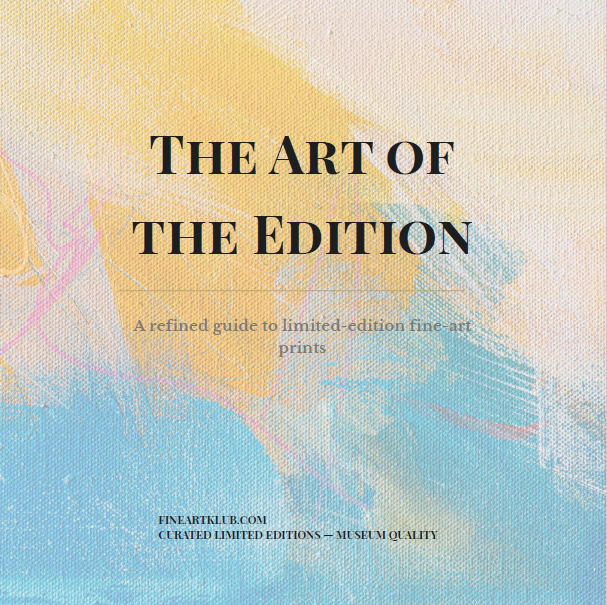
It is precisely this tension — between infinite reproduction and intentional limitation — that forms the foundation of The Art of the Edition, an essay-based ebook published by Fineartklub. The book explores why editions still matter, what they represent culturally and philosophically, and how craft, material, and intention restore meaning to art in an age of abundance.
This article expands on those ideas, while guiding readers toward deeper resources for understanding contemporary fine-art prints, editions, and collecting today.
The Problem With Infinite Images
Digital technology promised accessibility. And in many ways, it delivered. Art is now visible everywhere — on screens, feeds, websites, and platforms that flatten centuries of artistic practice into a single scroll.
But accessibility came at a cost.
When everything is available, nothing feels chosen.
Images lose gravity when they are endlessly reproducible. Without boundaries, art becomes content: interchangeable, fleeting, optimized for engagement rather than encounter. The act of looking — once central to the experience of art — is replaced by scanning.
This is not a critique of technology itself, but of what happens when reproduction replaces intention.
Why Editions Exist at All
Historically, editions were never about mass production. From early lithography to modern giclée printing, fine-art editions emerged as a way to extend an artwork without erasing its integrity.
An edition establishes:
A defined relationship between artist and viewer
A commitment to material quality
A finite body of work that resists endless replication
In The Art of the Edition, editions are framed not as market devices, but as ethical structures — decisions about how art enters the world, how it is encountered, and how it endures.
This distinction matters, especially today.
Limitation as Meaning, Not Scarcity
One of the most persistent misunderstandings around limited editions is that they exist primarily to create artificial scarcity. But scarcity alone does not create value.
Intention does.
Limitation, when approached thoughtfully, does several things at once:
It slows down production
It increases responsibility
It restores attention
An edition asks both artist and collector to commit — not just to an image, but to a process, a material presence, and a shared understanding that this work is not infinite.
For a deeper exploration of this idea, Fineartklub’s essay on why limited edition quality and scarcity still matter offers a clear, grounded framework that moves beyond simplistic market narratives.
Craft as Resistance
In a digital environment, friction is often framed as a flaw. In art, friction is a feature.
Fine-art printing — particularly museum-quality giclée — is a craft that demands patience, calibration, and material sensitivity. Pigment-based inks, archival cotton papers, and precise color management are not conveniences. They are commitments.
The Art of the Edition devotes significant attention to this craft, exploring:
Why pigment inks matter for longevity
How paper texture alters emotional perception
Why materials are inseparable from meaning
A print is not merely an image transferred onto paper. It is an object shaped by decisions — each one influencing how the work is experienced over time.
This philosophy aligns closely with broader conversations in the art world about hand-finished works. A thoughtful perspective on this can be found in why hand-finished fine-art prints matter more than ever, which highlights how subtle human intervention restores intimacy in reproducible media.
The Difference Between Reproduction and Edition
Not all prints are editions.
A reproduction aims to replicate an image as efficiently as possible. An edition, by contrast, is defined by authorship, limitation, and material care.
An edition is typically:
Signed by the artist
Numbered within a fixed run
Produced using archival methods
Accompanied by provenance
These elements do not exist for prestige. They exist to ensure that what the viewer holds is not merely an image, but a trace of artistic intent.
For readers seeking a comprehensive grounding in this distinction, Fineartklub’s complete guide to fine-art prints offers an accessible, well-structured overview of print types, techniques, and quality markers.
Collecting as an Act of Attention
To collect art is not to accumulate objects. It is to cultivate attention.
The modern collector is increasingly aware that meaning does not scale. A wall filled with images rarely resonates as deeply as a single work chosen carefully and lived with over time.
Limited-edition prints support this mode of collecting because they:
Invite repeated viewing
Develop presence within a space
Reward familiarity rather than novelty
In The Art of the Edition, collecting is framed as a relationship — one that unfolds slowly, shaped by proximity, memory, and care.
This perspective challenges the idea that art must constantly perform or circulate to remain relevant.
Why Editions Matter More Now, Not Less
Paradoxically, the more images circulate, the more meaningful limitation becomes.
In a culture defined by speed, editions introduce pause.
In a system optimized for quantity, they assert quality.
In an environment of constant availability, they make room for choice.
This is why limited editions are not relics of the past, but structures of resistance within contemporary culture.
They preserve:
Time
Material presence
Ethical authorship
They remind us that art does not exist to fill feeds, but to occupy space — physical, emotional, and intellectual.
About The Art of the Edition
The Art of the Edition is a digitally published, essay-based ebook by Fineartklub that explores these ideas in depth.
Rather than offering technical instruction or market advice, the book provides a conceptual and cultural framework for understanding limited-edition fine-art prints today. Topics include:
The legacy of fine-art printing
What makes an edition valuable beyond price
The philosophy of limitation
The role of craft, paper, and pigment
The ethics of reproduction
The ebook can be accessed via the Fineartklub Publications page or directly through the dedicated page for The Art of the Edition.
Both pages provide context, positioning, and access to the full text.
Building a Thoughtful Art Ecosystem
One of the strengths of the contemporary art ecosystem is the growing network of independent platforms dedicated to thoughtful discourse, curation, and education.
Alongside Fineartklub, platforms such as Art Funkie contribute to this landscape by highlighting emerging practices, trends, and conversations within contemporary art.
Together, these spaces form a counterbalance to algorithm-driven culture — offering slower, more intentional ways of engaging with art.
Choosing Less, Seeing More
Limited editions do not solve the problems of image saturation on their own. But they offer a model — one rooted in intention rather than accumulation.
They ask:
What is worth preserving?
What deserves time?
What should remain finite?
The Art of the Edition exists for readers who are asking these questions — artists, collectors, and viewers who believe that art still deserves material presence, thoughtful making, and sustained attention.
In choosing less, we often see more.
