
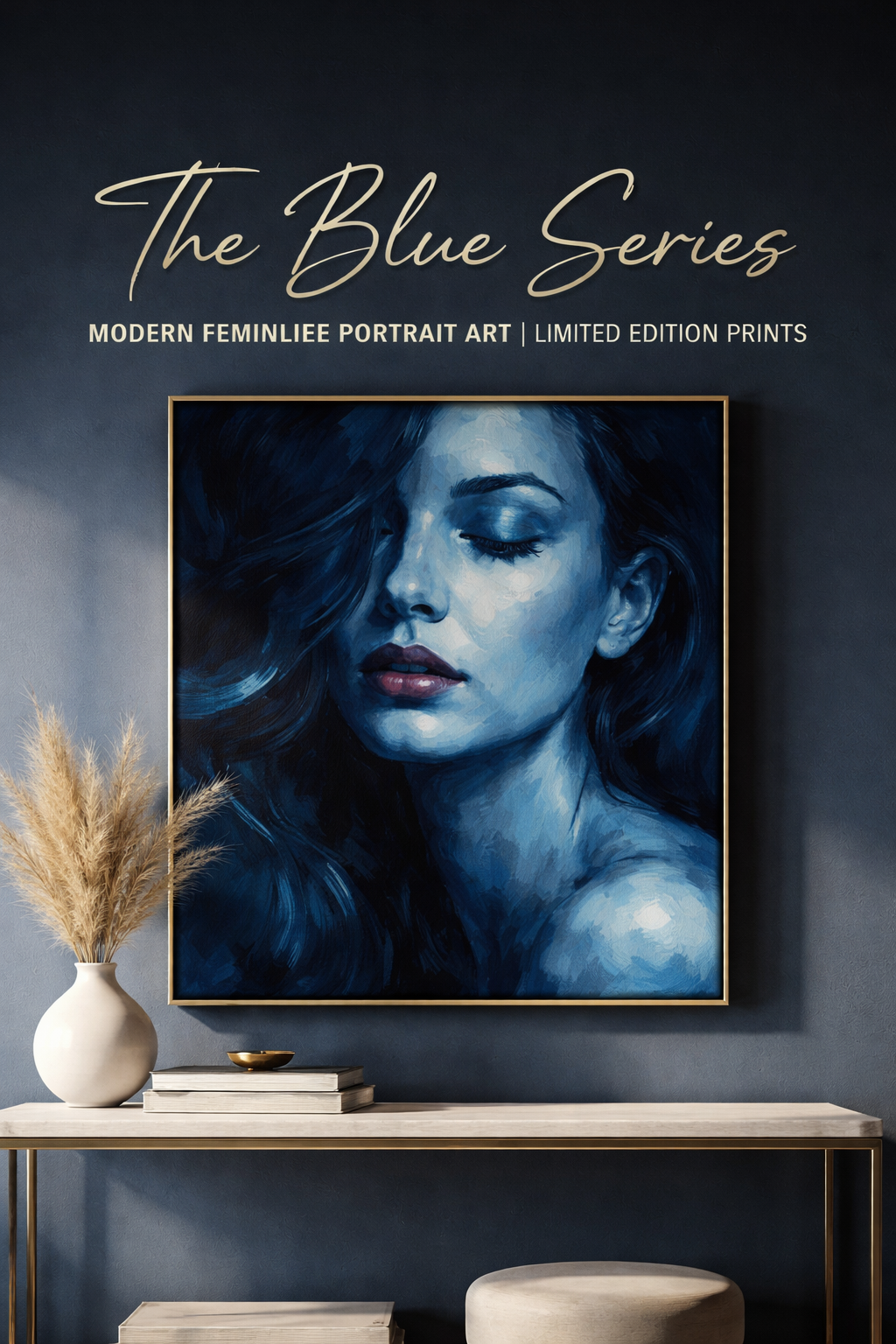
The blue series – where modern portrait art meets collectible fine art prints
Introduction
There is a shift happening in the art world.
Not loud. Not dramatic. But clear.
Collectors are moving away from purely decorative wall art and toward something more intentional—artworks that carry emotional weight, material quality, and long-term value. Pieces that feel considered. Grounded. Almost permanent.
This is exactly where the Blue Series enters the conversation.
At first glance, it is minimalist. A restrained palette. Controlled compositions. Faces emerging from deep blue tones. But the deeper you look, the more layers begin to reveal themselves—not only visually, but structurally.
Because this is not just about painting.
It is about how those paintings become objects.
For a deeper understanding of the artistic foundation, you can explore
the Blue Series – modern feminine portrait art in deep blue tones, where the visual language behind the work is explored in detail.
What makes the series particularly interesting is the way it combines:
Contemporary portrait art
Limited edition printmaking
Museum-grade materials
Artist intervention on each piece
This combination changes everything.
It turns an image into something collectible.
The shift toward limited edition fine art prints
 Collectors today are more informed than ever.
They understand the difference between a poster and a print. Between mass production and controlled editions. Between decoration and ownership.
That shift has led to a growing interest in limited edition fine art prints.
Not as a compromise. But as a category in its own right.
A limited edition print means one simple thing:
A fixed number of works will ever exist.
That’s it.
No reprints. No restocks. No scaling.
And that creates something powerful: scarcity.
But scarcity alone is not enough.
What matters is how it is combined with quality and intention.
In the Blue Series, editions are deliberately kept small:
1/10 for large formats
Carefully controlled production
No expansion after release
This places the work in a very specific category:
high-value, low-volume collectible editions
If you want to understand how this impacts long-term perception and value, take a look at
limited edition prints and their market value, where scarcity is directly tied to collector demand.
And this is where things become interesting.
Because once an edition is sold out, it is gone.
Forever.
Hahnemühle paper – the foundation of the artwork
Material matters.
More than most people think.
In fine art printing, paper is not just a surface—it is part of the artwork itself. It affects how colors are perceived, how light interacts with the image, and how the piece ages over time.
All Blue Series is printed on Hahnemühle fine art paper.
This is not a random choice.
Hahnemühle is widely used in museum-grade printing because it offers:
Exceptional color depth
Subtle surface texture
Long-term archival stability
Resistance to fading
This is especially important in monochromatic work.
Because when your entire composition is built around variations of a single color—like blue—every small nuance matters.
A cheaper paper would flatten the image. Remove depth. Kill the subtlety.
But here, the texture becomes part of the experience.
You don’t just see the artwork.
You feel it.
If you want to understand why collectors care so much about this, read
why museum-grade paper matters to collectors, where material quality is directly linked to longevity and value.
Because in the end, a print is only as strong as the surface it lives on.
Certificate of authenticity – trust is everything
In the world of collectible art, trust is not optional.
It is foundational.
That is where the Certificate of Authenticity (COA) comes in.
Each Blue Series print is accompanied by a COA that confirms:
The artwork is genuine
The edition is fixed
The artist has approved the print
The piece belongs to a specific numbered series
This creates a traceable relationship between artwork and owner.
And often, this is reinforced with:
Serial numbers
Matching identifiers
Secure documentation
Why does this matter?
Because without authenticity, there is no value.
A print without verification is just an image.
A print with provenance becomes an asset.
Hand-finished details – where prints become unique
This is where the Blue Series separates itself completely.
Because not all prints are identical.
Even within the same edition.
Selected works include hand-finished details.
That means the artist physically interacts with each print after production.
Small interventions. Subtle additions. But enough to change the surface.
This creates something rare:
A print that behaves like an original.
Each piece becomes slightly different.
You might see:
Additional brush touches
Texture variations
Surface enhancements
Material accents
No two pieces are exactly the same.
And that changes the relationship between collector and artwork.
Because now you are not just buying an edition.
You are acquiring a unique variation within that edition.
If you want to explore how this elevates prints, see
what makes each fine art print unique, where craftsmanship becomes part of value.
This is where reproduction ends.
And art begins again.
Signed and numbered – the language collectors understand
There are certain signals in the art world that immediately communicate value.
Signature is one of them.
Edition number is another.
Each Blue Series print is:
Signed by the artist
Numbered (e.g. 1/10, 2/10…)
Part of a fixed edition
This system does two things:
Confirms authenticity
Defines scarcity
Collectors understand this instantly.
A 1/10 edition is not just a number.
It is a statement.
It says:
Only ten exist
This is one of them
No more will ever be created
That clarity matters.
Because in art, ambiguity reduces value.
Structure increases it.
Blue as identity – not just color
Blue is not just a color in this series.
It is the foundation.
The structure.
The atmosphere.
The identity.
It shapes how the artwork is experienced.
The Blue color has always carried meaning:
Calm
Depth
Control
Distance
Presence
But in portrait art, it does something else.
It removes literal interpretation.
You are no longer just looking at a face.
You are engaging with a mood.
A state of mind.
This is explored further in
the meaning of blue in art, where the psychological impact of the color is examined.
And this is where the Blue Series becomes more than visual.
It becomes emotional architecture.
Interior impact – from artwork to atmosphere
Art does not exist in isolation.
It lives in space.
And the way it interacts with that space defines its impact.
The beautiful Blue Series works particularly well in modern interiors because it balances presence and restraint.
It does not overwhelm.
But it does not disappear.
Instead, it anchors the room.
You will often see it used in:
Scandinavian living spaces
Minimalist interiors
Modern bedrooms
Architectural environments
Where color is limited and structure is clean.
In these settings, a single piece can:
Define the mood
Create depth
Add identity to the space
This is explored in
why blue portrait art feels powerful in interiors, where placement and tone become part of the design.
Because great art does not decorate a room.
It shapes it.
Contrast – where other art movements go in a different direction
Not all contemporary art follows this path.
Some movements go the opposite way.
More color.
More chaos.
More expression.
That contrast is important.
Because it defines what the Blue Series is not.
For example, you can explore
pop and street art today, where visual language is driven by energy and rebellion.
These works are loud. Immediate. Direct.
The Blue Series is the opposite.
Controlled
Quiet
Intentional
Both have value.
But they create very different experiences.
From image to collectible object
This is where everything comes together.
Because the Blue Series is not just about visuals.
It is about structure.
Each piece combines:
Limited edition (1/10)
Hahnemühle paper
Signed + numbered
Certificate of authenticity
Hand-finished details
That combination transforms the work.
It becomes:
A visual object
A physical object
A collectible object
And that is a completely different category than standard wall art.
For collectors looking to understand this shift, it is worth exploring
fine art print investing for collectors, where aesthetics and value intersect.
Because at this level, you are not just buying something to hang.
You are building something to keep.
Closing
We live in a time where images are everywhere.
Endless. Disposable. Forgettable.
But real art still stands apart.
Not because it is louder.
But because it is more intentional.
The Blue Series represents that shift.
A move toward:
Fewer pieces
Higher quality
Stronger identity
Deeper connection
It slows things down.
And in doing so, it creates something rare.
Not just something you look at.
But something you return to.
