
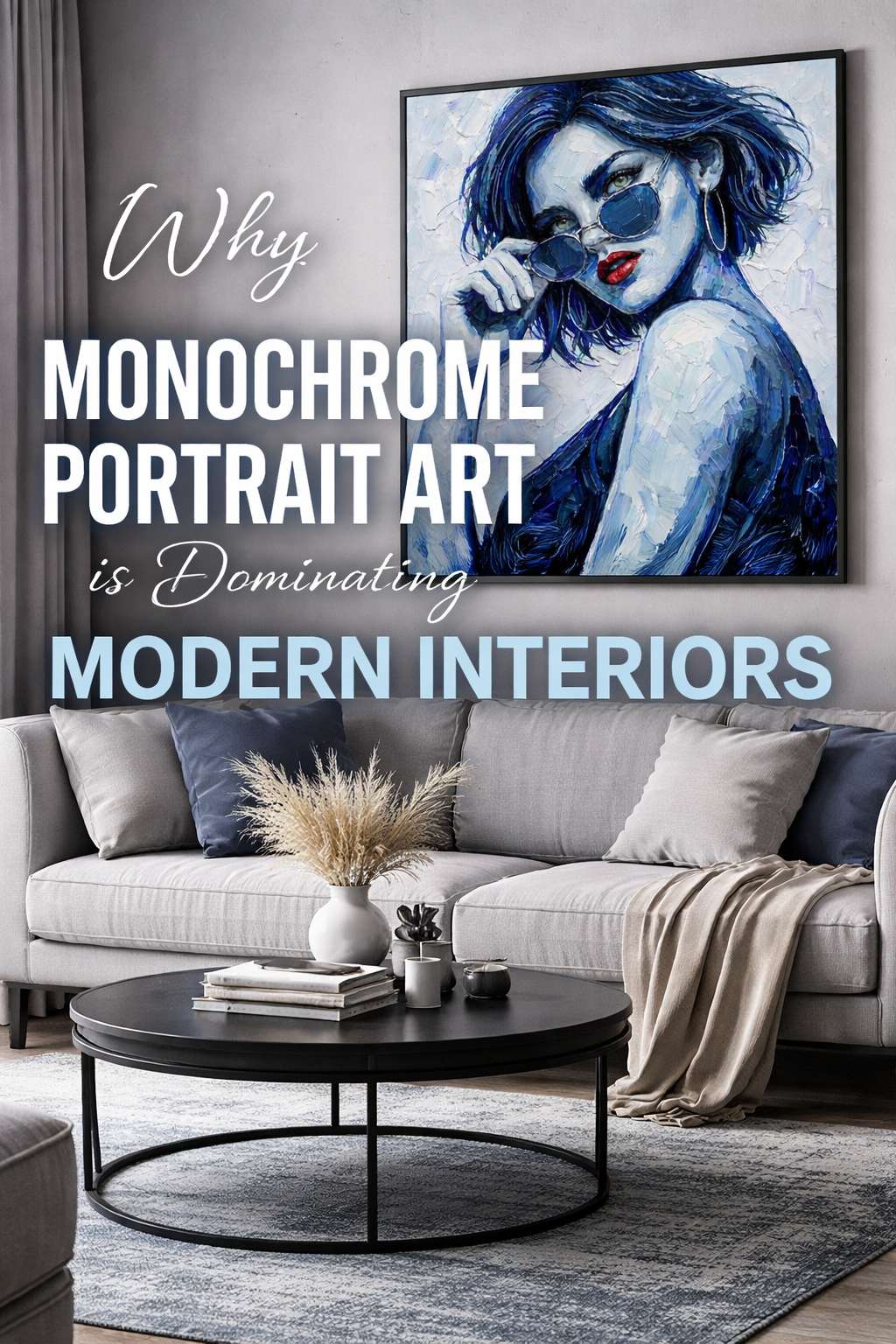
Why monochrome portrait art is dominating modern interiors
Introduction to monochrome portrait art
Step into almost any modern interior today and you will notice a shift.
Fewer colors.
Cleaner lines.
More intention.
And on the walls—very often—one dominant artwork. Not a gallery wall. Not a mix of styles. Just one piece holding the space.
Increasingly, that piece is monochrome.
Especially portrait-based.
Monochrome portrait art has quietly become one of the most defining visual elements in contemporary interiors. It does not compete. It does not overwhelm. It anchors.
At first glance, it might seem like a minimalistic trend. But that is only part of the story. Because what is really happening is deeper than aesthetics.
It is about control.
Presence.
Emotional clarity.
And a new way of thinking about how art interacts with space.
The power of reduction
 Modern interiors are moving toward reduction.
Not emptiness. Not absence. But focus.
Designers and homeowners are increasingly removing unnecessary elements to allow the important ones to stand out. Furniture is simplified. Materials are refined. Color palettes are limited.
And that creates a problem.
What do you put on the walls?
Because traditional art—full of color, detail, and narrative—can easily disrupt the balance of a minimal space. It becomes noise instead of structure.
This is where monochrome portrait art becomes powerful.
By reducing the visual language to one dominant tone, the artwork aligns with the room rather than fighting it. But at the same time, the portrait itself introduces something deeply human.
That contrast matters.
You get:
Simplicity in color
Complexity in expression
Balance in composition
Instead of overwhelming the room, the artwork completes it.
Why portraits work better than abstract in minimal spaces
Minimal interiors often rely heavily on abstract art.
It makes sense. Abstract work is flexible. It does not impose a narrative. It blends easily into a space.
But it also has a limitation.
It lacks connection.
Monochrome portrait art solves that.
Because even when the palette is reduced, the human face creates an immediate emotional response. You recognize it instantly. You engage with it, even if you cannot explain why.
A slight tilt of the head.
A gaze that avoids you.
A presence that feels calm but controlled.
These details create tension.
And tension is what gives a room depth.
A monochrome portrait does not shout for attention. But it holds it.
This is one of the reasons why series like the Blue Series have gained attention, as they combine restrained color with strong emotional presence, allowing the artwork to remain subtle while still becoming the focal point of the space.
The emotional role of color when reduced to one tone
 Color behaves differently when it stands alone.
In multi-colored artworks, color competes. It creates contrast, movement, and hierarchy. But in monochrome work, color becomes atmosphere.
It defines everything.
Take blue, for example.
Blue is not aggressive. It does not push forward. It pulls inward.
It creates:
Calm
Distance
Depth
Control
But within that calm, there is also tension.
A darker blue can feel heavy.
A lighter blue can feel fragile.
A slightly altered tone can completely change the emotional reading of a piece.
This is what makes monochrome portrait art so effective.
You are not just looking at an image. You are entering a mood.
This is explored further in the meaning of blue in art, where the psychological impact of blue is not just aesthetic, but deeply tied to identity and perception.
When color is reduced, every variation becomes significant.
And that creates intensity without complexity.
One artwork instead of many
Another major shift in modern interiors is the move away from gallery walls.
For years, the trend was to fill walls with multiple pieces. Different sizes. Different frames. Different styles.
It created variety. But it also created noise.
Today, the trend is moving toward fewer pieces. Larger scale. Stronger presence.
One artwork instead of many.
This approach requires something very specific.
The artwork must be able to hold space on its own.
Not through size alone. But through presence.
Monochrome portrait art is particularly effective here because it combines:
Visual simplicity
Emotional depth
Strong composition
It does not need support from other works.
It stands alone.
In a living room, it can define the entire atmosphere.
In a bedroom, it can introduce calm without becoming passive.
In a hallway, it can create a sense of movement and direction.
This is not decoration.
It is spatial structure.
Texture becomes more important than color
When color is reduced, other elements become more important.
Texture is one of them.
In monochrome portrait art, texture replaces contrast.
Brushstrokes become visible.
Surfaces shift between smooth and expressive.
Edges dissolve and reappear.
These details create variation without introducing new colors.
And this is where material quality becomes critical.
Because if the artwork is reproduced poorly, all of that nuance disappears. The surface becomes flat. The depth is lost.
High-quality fine art printing—especially on textured papers—allows the artwork to retain its character.
You can see the layers.
You can feel the surface.
And that makes a difference.
Because in monochrome work, subtlety is everything.
The relationship between art and architecture
Modern interiors are increasingly influenced by architecture.
Not just in structure, but in thinking.
Clean lines. Open spaces. Natural light.
Art is no longer something that is simply added at the end. It is considered part of the architectural composition.
This changes how artwork is selected.
Instead of asking:
“What looks good here?”
The question becomes:
“What belongs here?”
Monochrome portrait art fits naturally into this mindset because it behaves almost like an architectural element.
It does not disrupt the structure.
It reinforces it.
The vertical lines of a portrait can echo the height of a room.
The color tone can align with materials like concrete, wood, or stone.
The composition can create balance within the space.
This integration is what makes the artwork feel intentional rather than decorative.
Calm is becoming a luxury
There is another reason why monochrome art is becoming more dominant.
We are surrounded by noise.
Screens. Notifications. Colors. Movement.
Everything competes for attention.
And that changes what people want in their homes.
They want calm.
Not empty spaces. But controlled ones.
Monochrome portrait art delivers that.
It slows things down.
It reduces visual pressure.
It creates space for reflection.
But at the same time, it does not become boring.
Because the human element keeps it alive.
The face. The expression. The presence.
There is always something to return to.
Subtle luxury and quiet confidence
Luxury is changing.
It is no longer about showing everything.
It is about choosing carefully.
Fewer pieces. Higher quality. More intention.
Monochrome portrait art fits perfectly into this shift.
It does not try to impress.
It does not rely on bold colors or complex compositions.
Instead, it communicates through restraint.
That restraint creates a different kind of confidence.
Quiet. Controlled. Certain.
This is particularly evident in modern feminine portrait art, where strength is expressed not through exaggeration, but through presence.
The subject does not perform.
She exists.
And that is enough.
Why this trend is not going away
Some trends come and go quickly.
Bright colors. Maximalism. Decorative overload.
Monochrome portrait art is different.
Because it is not driven by trend.
It is driven by fundamentals:
Simplicity
Balance
Emotional connection
Material quality
These are not temporary ideas.
They are foundational.
As long as interiors continue to move toward minimalism and intention, monochrome artwork will remain relevant.
And as collectors become more aware of quality and structure, the demand for works that combine visual impact with collectible value will only increase.
Closing
Monochrome portrait art is not dominating modern interiors by accident.
It is the result of multiple shifts happening at the same time:
A move toward minimalism
A desire for emotional connection
A focus on material quality
A redefinition of luxury
It works because it balances opposites.
Simple, but complex.
Calm, but present.
Subtle, but powerful.
And in a world that is increasingly loud, that balance is exactly what people are looking for.
Not more.
Just better.
