
Beyond the tourist trail: local things to do in Málaga
Most people who visit Málaga spend their time on Calle Larios, walk up to the Alcazaba, take a photo of the Cathedral and then wonder why the city felt a bit flat. I did exactly the same thing when I first arrived here from Denmark a couple of years ago. It took me a few months of actually living here to understand that Málaga rewards the people who slow down and look a little harder.
This is not a standard tourist guide. It is written from the perspective of someone who lives here, shops here, eats here and walks through the same streets most days. Málaga is genuinely one of the best cities in southern Europe to spend time in – but the version most visitors see is only a fraction of what the city actually has to offer.
If you want food, hidden corners, local neighbourhoods, viewpoints, slow mornings and easy day trips to places like Nerja and Granada, this is the guide for you. Most of it costs very little. None of it requires a tour bus.
💡 Fun fact: Málaga is the birthplace of Pablo Picasso, but it is also one of the sunniest cities in Europe with an average of around 300 days of sunshine per year. The weather alone is a reason to stay longer than you planned.
Start in Málaga Centro, but don’t stay only there
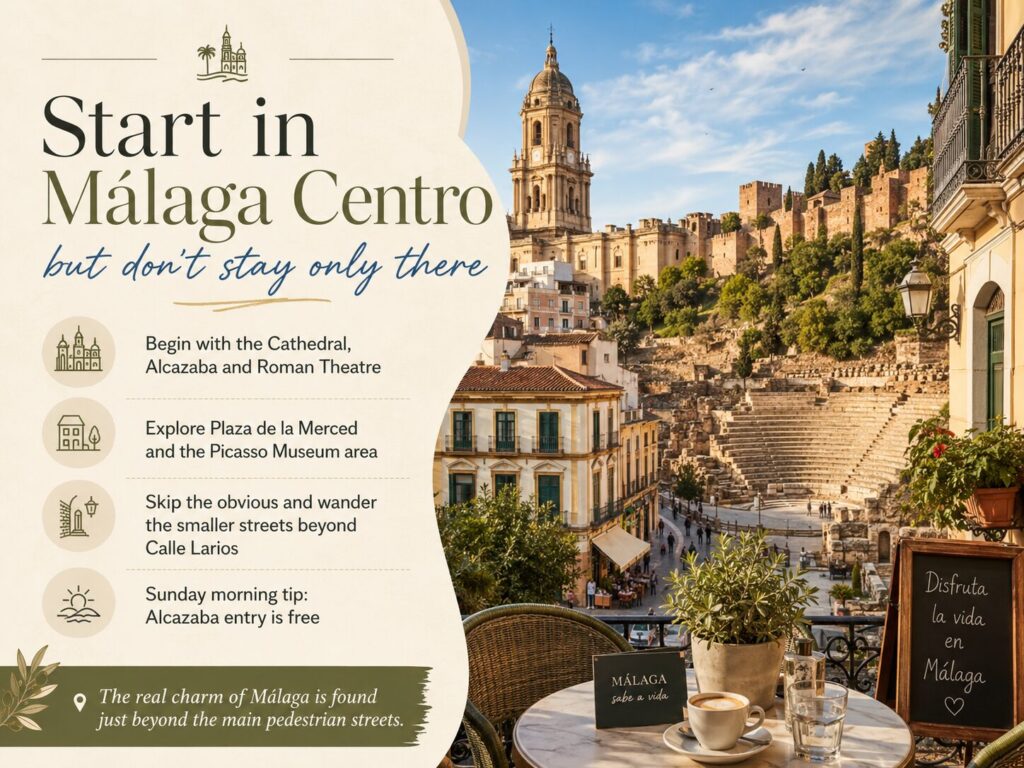 The historic centre is the obvious starting point and there are good reasons for that. The Cathedral is genuinely impressive, especially if you walk around the outside rather than rushing straight in. The Alcazaba is one of the best-preserved Moorish fortresses in Andalusia and the views from the top over the port and the city are worth the climb even on a warm day. The Roman Theatre just below the Alcazaba is free to walk past and look into, and the combination of Roman ruins next to a Moorish fortress next to a modern city says a lot about how layered Málaga actually is.
The Picasso Museum on Plaza de la Merced is worth a visit, though the square itself is equally interesting. It is where Picasso was born, and the neighbourhood around it has a slightly different energy from the main shopping street – more local, more lived-in, more interesting.
The mistake most visitors make is staying only on the main pedestrian streets. Calle Larios is fine, but it is essentially a shopping street with expensive cafés on either side. The more interesting parts of the centre are the narrower streets that branch off it, particularly heading towards the old town and the areas around the Cathedral.
For a proper guide to the parts of Málaga that most visitors walk straight past, the hidden gems in Málaga guide on Costatable covers it in detail and is worth reading before you go.
📍 Nice to know: The Alcazaba entrance fee is around €3.50, but if you time your visit for a Sunday morning it is free. The Roman Theatre below is always free to view from outside.
Look for the smaller squares and local streets
This is the part of Málaga that most visitors never find, and it is also the part I like most about living here. Away from the main tourist circuit, the city is full of small squares, quiet side streets and neighbourhood corners that have barely changed in decades.
Plaza de la Merced, Plaza Uncibay and Plaza de la Constitución are the ones everyone knows. But walk five minutes in almost any direction from those and you start finding places that feel genuinely local. Small bars with three tables outside, bakeries that have been in the same family for generations, corners where old men sit in the shade and watch the world go by without any interest in being photographed.
The area around Calle Granada and the streets heading towards Soho is particularly good for this. Soho itself has changed a lot in recent years – it has become Málaga’s arts and culture neighbourhood, with street art, independent galleries, small boutique hotels and a crop of genuinely good restaurants and cafés that attract more locals than tourists.
The Lagunillas neighbourhood, slightly further from the centre, is another one worth exploring if you want to see a side of Málaga that feels completely different from the polished tourist zone. It is scruffier, more authentic and has a few excellent local bars where a beer and some tapas will cost you considerably less than anywhere near Calle Larios.
For a more detailed look at the lesser-known places in Málaga that most visitors miss, that guide covers the neighbourhoods and corners worth adding to your route.
💡 Fun fact: The street art in Soho is not random – it was commissioned as part of a deliberate project to transform the neighbourhood, and some of the murals are by internationally recognised artists. It is effectively an open-air gallery that is completely free to walk through.
Make food part of the travel experience
In Málaga, food is not something you do between sightseeing. It is part of the experience itself. The city has a strong food culture that goes well beyond the tourist menus and overpriced paella you find near the beach. If you are willing to walk a couple of streets away from the obvious spots, you will eat significantly better and spend less money doing it.
The local food culture is rooted in fresh ingredients, simple preparation and an almost religious commitment to eating at the right time. Lunch is the main meal of the day and it happens between 14:00 and 16:00. Dinner starts at 21:00 at the earliest and often runs until midnight. If you try to eat dinner at 19:00, you will have most restaurants to yourself – because the locals have not arrived yet.
Seafood is a strength here. Espetos – sardines grilled on a skewer over an open wood fire on the beach – are one of those things that sound simple and taste extraordinary. The chiringuitos along the beachfront do them properly, and eating espetos at a table in the sand with a cold beer is one of the more purely enjoyable things you can do in Málaga.
Beyond seafood, the brunch and café scene has developed enormously in recent years. There are now places in the centre doing genuinely excellent food using fresh, high-quality ingredients in a way that would not feel out of place in London or Copenhagen. For a full overview of where to eat well across different styles and budgets, the guide to the best restaurants in Málaga covers the options honestly.
If you want to focus specifically on the brunch side of things, the best brunch in Málaga guide goes into detail about the strongest options in and around the centre.
📍 Nice to know: Málaga has its own local wine called Málaga DO – a sweet wine made from Muscat and Pedro Ximénez grapes that has been produced in the region for centuries. It is not to everyone’s taste, but trying a small glass at a traditional bar is worth doing at least once.
Add a slow morning: brunch, coffee or a terrace
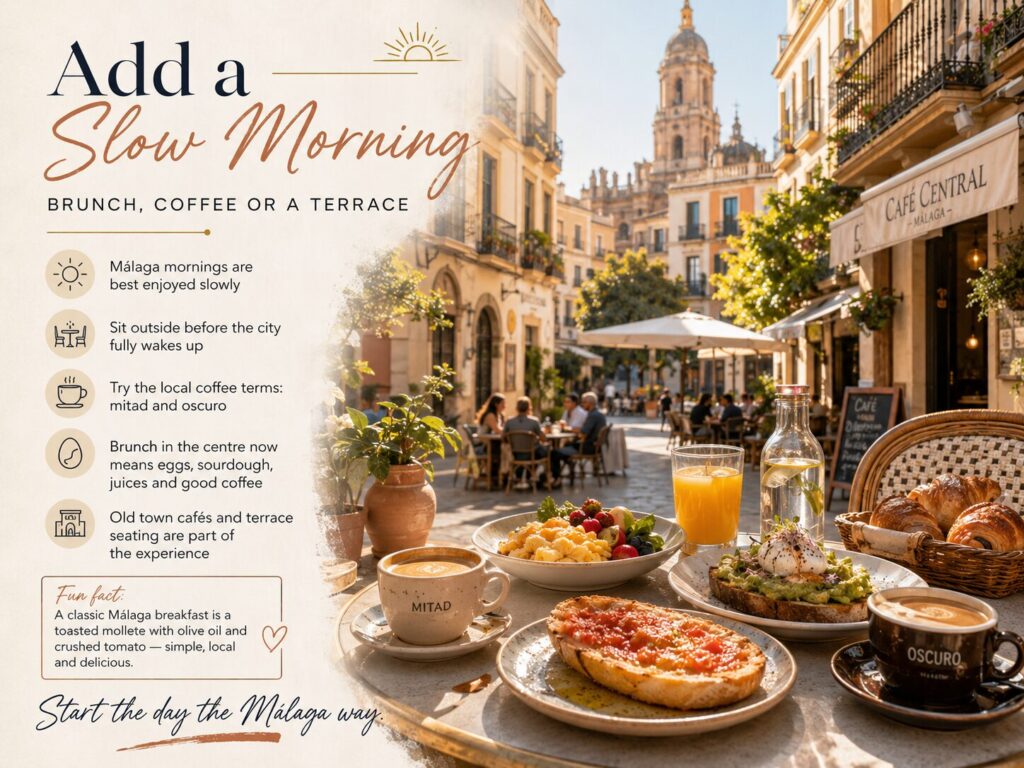 One of the things I genuinely love about living in Málaga is the morning pace. On a weekday, the streets around the old town are calm before 10:00. On a weekend, there is a slow, relaxed energy that invites you to sit outside with a coffee and do absolutely nothing useful for an hour or two. I would strongly recommend embracing this rather than trying to fight it with a packed itinerary.
The coffee culture here is interesting. Málaga has its own local coffee terminology that is different from the rest of Spain. A “mitad” is half coffee and half milk, which is roughly what most people would call a flat white. An “oscuro” has more coffee and less milk. Getting the local order right is a small thing that makes you feel less like a tourist, and the coffee at most traditional bars is genuinely good.
The brunch scene has grown alongside the coffee culture. There are now several dedicated brunch restaurants in the centre that do proper weekend plates – eggs, avocado, sourdough toast, fresh juices, smoothies and more – in settings that are worth sitting in for an hour rather than rushing through. Outdoor seating on a small square, good coffee and food made from fresh ingredients is a very good way to start a day in Málaga.
For the best café options in the historic area, the guide to the loveliest cafés in Málaga old town has specific recommendations with locations and what to order.
💡 Fun fact: The traditional Málaga breakfast at a local bar is a “mollete” – a soft, slightly floury bread roll – toasted and served with olive oil and crushed tomato. It costs around €1.50-2.00 at a proper local bar and is one of the best simple breakfasts you can eat anywhere.
Use Málaga as a base for day trips
This is one of the things that makes Málaga genuinely excellent as a place to spend a week rather than a weekend. Within an hour by car or public transport, you can reach a completely different type of landscape, town or experience. Most visitors do not take full advantage of this, which is a shame.
Nerja is the most popular day trip from Málaga and for good reason. It is a small coastal town about 50 kilometres east of the city with dramatically beautiful cliffs, clear water and a famous natural landmark – the Balcón de Europa, a promenade built on a headland with views in both directions along the coast. It is busier in summer than it used to be, but if you go on a weekday morning and walk down to the less-visited beaches below the town, it still feels relatively unspoilt. For everything worth seeing and doing there, the guide to things to do in Nerja is the most useful starting point.
Granada is a longer trip – around an hour and a half by bus or train – but it is one of those places that genuinely justifies the journey. The Alhambra palace complex is extraordinary and unlike anything else in Spain. Book the tickets well in advance, because they sell out weeks ahead in high season. But Granada is also worth visiting even if you cannot get Alhambra tickets – the Albaicín neighbourhood, the cathedral, the tapas culture (free tapas with every drink, still, in most bars) and the energy of a university city all add up to a very full day. The guide to things to do in Granada covers it properly.
The white villages of the Axarquía region, east of Málaga, are less visited and equally rewarding. Frigiliana, just above Nerja, is probably the most beautiful of them – a genuinely stunning hilltop village of whitewashed houses and narrow lanes that feels almost impossibly picturesque. Comares, further inland, has extraordinary views from its hilltop position and almost no tourists at all.
📍 Nice to know: The bus from Málaga to Nerja takes about an hour and costs around €4-5 each way. It runs frequently and drops you right in the centre of town. No car needed, no parking stress.
Plan around time of day
Málaga rewards people who think about timing. The city changes completely depending on what time you are there, and planning around that makes a real difference to the experience.
Morning, before 11:00, is the best time for the old town. The streets are cool, quiet and mostly tourist-free. This is when the local bars fill up with people having their first coffee and mollete of the day, and when you can walk through the Cathedral area and the Alcazaba neighbourhood without feeling like you are part of a crowd. If you want to visit the Alcazaba itself, morning is the best time – cooler, fewer people, better light for photos.
Afternoon is museum time or beach time. The Picasso Museum, the Carmen Thyssen Museum and the Centre Pompidou Málaga are all worth a couple of hours each and are best visited between 14:00 and 18:00 when the outdoor temperature peaks in summer. The beach at La Malagueta is a short walk from the centre and is perfectly decent for a swim, though the beaches further east towards El Palo and Pedregalejo are better and more local in feel.
Evening and sunset are when Málaga is at its most beautiful. The light on the Cathedral and the old town streets turns golden, the terraces fill up, and the city shifts into a slower, more social gear. A sunset dinner in Málaga with a view is one of those experiences that is hard to replicate anywhere else – the combination of warm evening air, good food and that particular Andalusian light is genuinely special.
💡 Fun fact: The Centre Pompidou Málaga was the first Centre Pompidou outside of France. It opened in 2015 and is housed in a striking glass cube structure at Muelle Uno. The permanent collection alone is worth the entry fee.
Common mistakes visitors make in Málaga
 Living somewhere long enough teaches you what the mistakes are. Here are the ones I see most often.
Staying only on the busiest streets is the biggest one. Calle Larios and the immediate surrounding area are convenient but not representative of the city. The best food, the most interesting atmosphere and the better value for money are almost always one or two streets away.
Eating at random tourist restaurants near the Cathedral or the beach without checking them first. The menus with photos outside and a person standing at the door trying to pull you in are almost never worth it. Walk past them, find a place that looks like it is full of people who live here, and eat there instead.
Not checking opening hours is a surprisingly common issue. Many of the better smaller restaurants and cafés close between lunch and dinner – roughly 16:00 to 20:00 – and some do not open on Mondays. Arriving somewhere to find it shut is an avoidable frustration.
Trying to do too much in one day. Málaga is a city that rewards a slower pace. Two or three things done properly, with time to sit and eat and walk between them, will always feel better than six things done at a rush.
Ignoring the neighbourhoods outside the very centre. Soho, El Palo, Pedregalejo and the Lagunillas area all offer a version of Málaga that feels genuinely different from the tourist centre – and usually cheaper, quieter and more interesting.
Conclusion
 Málaga is one of those cities that gives back in proportion to the effort you put in. The surface layer – Cathedral, Alcazaba, Calle Larios, beach – is fine and worth doing. But the more interesting version of the city is the one you find by walking a few streets further, sitting down somewhere that is not in any guidebook, eating food made by people who care about it, and taking the time to watch the city rather than just move through it.
The combination of food, history, neighbourhoods, weather and easy access to places like Nerja and Granada makes Málaga one of the most complete bases for a trip to southern Spain. I moved here for a couple of years and I am still finding new corners worth knowing about. That, more than anything else, is probably the best recommendation I can give.

